Aloft · February 12, 2026
Shooting Through the Window: Making Honest Photographs from an Airliner Seat
The cabin window is the one lens element you never get to choose. Here is how I work with it - the scratches, the reflections, the vibration, the haze - instead of pretending it isn't there.
 By June “Goose” Aldaco · 6 min read
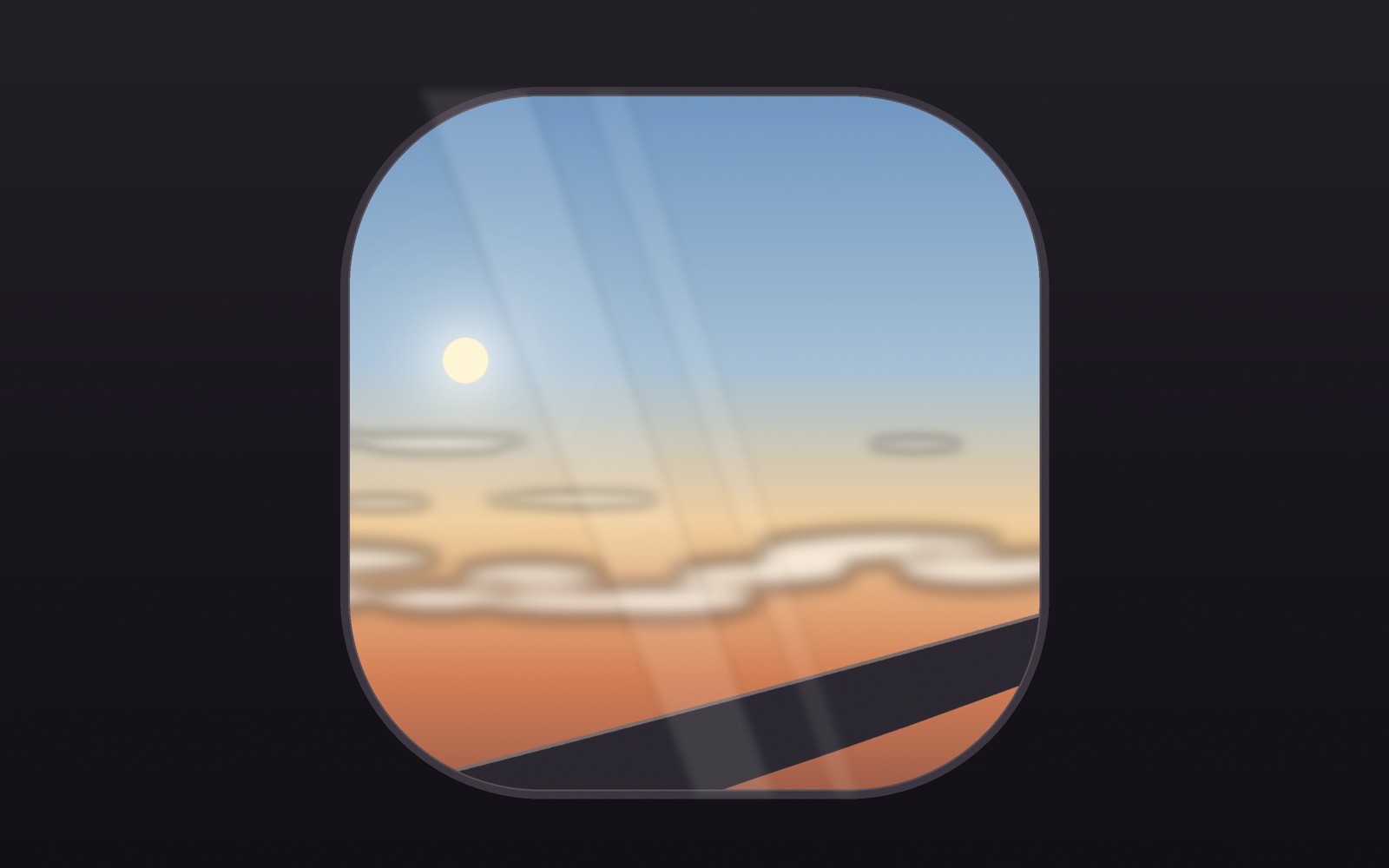
I have made some of my favorite photographs of the last decade through a scratched oval of acrylic about the size of a dinner plate. I have also lost frames I still think about - a dry lakebed in perfect raking light, gone soft because I let the lens touch the window. Photographing from an airliner is a craft of its own, and like most craft it comes down to understanding your materials. In this case, the material is the window.
The window is part of your lens
A cabin window is usually built as a sandwich: a thick structural outer pane, a middle pane behind it, and a thin inner pane - the one you can actually touch - that exists mostly to protect the others from us. The panes are acrylic rather than glass, and acrylic scratches easily, hazes with age, and bends light unevenly, especially toward the edges where the material curves.
The practical translation: shoot through the center of the window, where the panes are flattest and cleanest. Move your eye around before you raise the camera and find the least-scratched patch - every window has one. Wipe the inner pane with a microfiber cloth; it collects fingerprints, hair oil, and the ghost of every forehead that has leaned there. You cannot reach the other layers, but cleaning the one you can is worth a visible amount of clarity.
Accept, too, that the window costs you something no matter what you do - a little contrast, a little sharpness. The work is minimizing the loss, not eliminating it. That mindset alone will save you from chasing perfection you cannot have and missing the light you actually got.
Leave the polarizer in the bag
On the ground, a polarizing filter is the classic tool for cutting glare and deepening skies. In the air it backfires, and the reason is worth knowing. Acrylic panes are formed and installed under mechanical stress, and stressed plastic is birefringent - it rotates polarized light unevenly across its surface. Point a polarizer through it and the sky blooms with oil-slick bands of magenta and green, brightest exactly where you wanted clean blue.
I learned this the ordinary way, somewhere over Kansas, wondering why my sky looked like a soap bubble. The fix is absolute: no polarizer, ever, through a cabin window. If you want deeper skies, underexpose slightly and shoot raw; the color is recoverable later. The rainbow is not removable at all.
Reflections, and how to kill them
The cabin behind you is a lit room, and the window is a mirror facing it. Reading lights, seatback screens, a white shirt, the pale blur of your own face - all of it lands faintly on the frame, usually invisible until you are editing at home and there it is, floating over the Rockies.
- Get the front of the lens close to the pane, an inch or two away, without touching it.
- Cup your free hand around the gap, or press a soft rubber lens hood gently near - not against - the plastic.
- Wear something dark. A black sleeve is the cheapest anti-reflection device ever made.
- Kill your own light sources: reading lamp off, screen dimmed or dark.
At night this discipline becomes everything, because the ratio flips. The cabin is now brighter than the world outside, and every stray light prints itself onto the dark like a signature you did not mean to leave.
Vibration, shutter speed, and focus
The airframe hums. Engines transmit a fine, constant vibration through every structural surface, which is why the worst thing you can do is brace the camera against the window frame or sidewall - it feels stable and is precisely the opposite. Float the camera on your hands, elbows off the armrest, and let your body absorb what the airplane is doing. You are the tripod, and a decent one.
Then buy your sharpness with shutter speed. I treat 1/500 of a second as the floor in daylight and go faster whenever the light allows. At a typical cruise around 35,000 feet the ground moves slowly in the frame, so blur from forward speed is rarely the problem; the vibration is, and shutter speed is the cure.
Focus is its own small puzzle. Autofocus loves to hunt on featureless haze. Rather than trusting the infinity mark - many modern lenses focus past it - autofocus once on a hard edge like a wingtip, a cloud shadow, or a river bend, then switch to manual and leave it alone. Magnified manual focus on a distant edge works just as well, if your seatmate can tolerate the ritual.
Angles, heat shimmer, and haze
Where you sit relative to the wing decides what physics you are fighting. Behind the engines, exhaust heat rises in a ribbon of shimmer that smears anything seen through it - the same mirage effect as air over summer asphalt. If your window looks across the wing's trailing edge, whole landscapes will wobble. Usually that is a flaw. Occasionally it is the picture: I keep a frame of the Sandia Mountains taken through engine shimmer that looks like the range dissolving into heat, and I have stopped apologizing for liking it.
Ahead of the wing, the air is optically clean, and you often get the leading edge as a graphic anchor. Shoot slightly forward or backward of straight-down when you can; oblique angles give the land its relief, while views near the horizon pass through the most atmosphere and go milky first.
As for haze itself: shoot raw. Distance compresses contrast and shifts everything blue, and a raw file holds enough latitude to pull structure back out - a contrast curve and a modest white-balance correction will recover scenes that a jpeg has already flattened and baked in. This is the single biggest quality decision you make on the whole flight, and it happens in a menu before takeoff.
The shade, and the people around you
One last material: courtesy. The window shade is shared property. If the cabin is dark and people are sleeping, an open shade is a floodlight, and no photograph of clouds is worth being that person for five hours. I ask my row before a long session, keep the sessions short, and close the shade between them. When the crew asks for shades down, that request wins, every time.
Back home in Albuquerque I photograph snow geese at dawn from a blind, and the discipline is the same: you are a guest in a space built for something other than photography, working quietly inside its rules. A window seat is just another blind - smaller, faster, seven miles up. Treat it that way and it gives you the world.
Source notes
Facts in this essay were checked against the following public resources (search the titles to find them):
- Federal Aviation Administration, "Travelers"
- Transportation Security Administration, "Travel Tips"